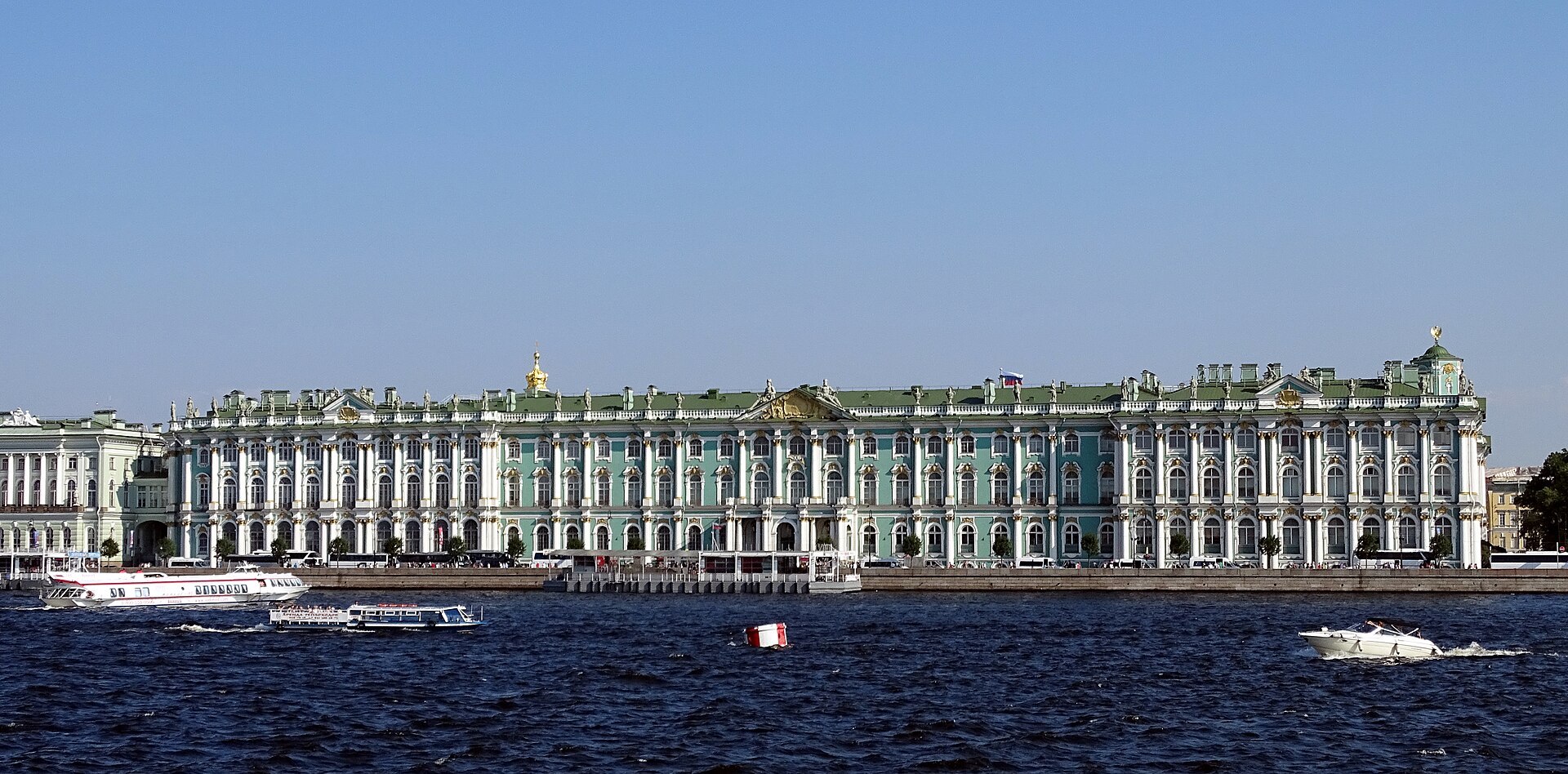
The Hermitage, Palace Square, and Nevsky Prospekt: your first day in the centre
The first day shapes itself: come out onto Palace Square, walk around the Alexander Column, take in the arch of the General Staff Building — and head into the Winter Palace. Do not try to see the whole Hermitage at once: pick two or three routes through the halls in advance and save the rest for your next visit.
Nevsky Prospekt, the main axis of the city, starts at Palace Square. Along the way it crosses the Moika, the Griboyedov Canal, and the Fontanka, with the Kazan Cathedral and its semicircular colonnade and the House of Books in the Singer Building standing on either side.
From the Griboyedov Canal, turn towards the Church of the Savior on Spilled Blood: the mosaic church with its multicoloured domes is one of the most recognisable buildings in the city. Right behind it are the Mikhailovsky Garden and the Russian Museum with its vast collection of Russian art.
In the evening, return to the Palace Embankment: from here you can see the Peter and Paul Fortress, the Spit of Vasilievsky Island, and the Rostral Columns. The Neva at sunset is Saint Petersburg’s best free attraction.
Vasilievsky Island, the Peter and Paul Fortress, and New Holland
The second day is best started at the Spit of Vasilievsky Island: the Rostral Columns, the Stock Exchange building, and the widest panorama of the Neva. Nearby are the Kunstkamera with its famous collection assembled under Peter the Great, and the island’s numbered lines with their quiet cafés.
Across the Neva stands the Peter and Paul Fortress, where the city began in 1703. Inside are the Peter and Paul Cathedral with its gilded spire and museum courtyards, while a sandy beach stretches along the fortress walls — in summer people sunbathe here with a view of the Winter Palace.
The Petrogradskaya Side beyond the fortress is a district of Art Nouveau apartment houses: Kamennoostrovsky Prospekt, leafy squares, and coffee shops that tourists rarely reach.
Towards evening, cross back to the left bank — to New Holland. The island park with its lawns, seasonal events, and restaurants in the buildings of a former shipyard makes a good pause between museums. From here it is a short walk to the Mariinsky Theatre and St Nicholas Cathedral in Kolomna, the quietest district of the historic centre.
Canals, drawbridges, and the imperial suburbs
Saint Petersburg was conceived as a city on the water, and it looks its best from the water. Tour boats run along the Moika, the Fontanka, and the Griboyedov Canal and come out into the Neva — an hour afloat replaces half a day on foot.
During the navigation season the bridges across the Neva are raised at night. The spectacle draws crowds to the embankments, but plan your timing: if your hotel is on Vasilievsky Island or the Petrogradskaya Side, you risk being stuck on the other bank until the bridges close again.
Set aside separate days for the suburbs:
- Peterhof — the Lower Park with its fountains and a view of the Gulf of Finland; in summer Meteor hydrofoils run here straight from the embankments in the centre;
- Tsarskoye Selo (Pushkin) — the Catherine Palace with the Amber Room and a vast park;
- Pavlovsk — a landscape park that is especially beautiful in autumn;
- Kronstadt — the Naval Cathedral and the forts in the Gulf of Finland.
All the suburbs are easy to reach on your own — by suburban train or bus, no guided tour required.
Seasons and the White Nights
Summer in Saint Petersburg is warm but never hot: daytime temperatures are around +21 °C in June, +22 °C in July, and +21 °C in August, with nights at +12…+14 °C. Rain can come on any day here — a light jacket is useful even in July.
The headline season is the White Nights in June, when evening imperceptibly flows into dawn. The city does not sleep at this time: the embankments are full of people, and the raising of the bridges turns into a night-time promenade. It is also the busiest period — book your hotel well in advance.
September is the calm alternative: around +16 °C during the day, shorter museum queues, and the opening of the theatre season. In October it gets noticeably colder — around +9 °C in the daytime.
Winter is mild for a northern city: around 0…−1 °C during the day and −3…−6 °C at night. In December Nevsky Prospekt is dressed in lights, and the short daylight hours are best filled with museums and theatres.
Spring arrives late: in April daytime temperatures reach only +8 °C, but by May they hit +16 °C — and the whole city pours out onto the streets and embankments at once.
Getting there and where to stay
Train, plane, and metro
From Moscow the easiest way is the Sapsan: four hours — and you are at Moskovsky station, right on Nevsky Prospekt, so your walk starts straight from the platform. Flights arrive at Pulkovo Airport south of the city; overnight trains suit those who do not want to lose a day to travel.
The best way around the city is on foot and by metro: the historic centre is compact, and the deep-level stations are an attraction in their own right. In summer, tour boats join the list.
Saint Petersburg has almost 1,400 hotels — the Saint Petersburg hotels catalogue lets you filter by district and price. At the low end of the popular options, the Saint Petersburg hotel starts at 8,640 ₽ a night with a 9.1 rating and more than 11,000 reviews on Moya Bron. The highest score — 9.8 — belongs to the Trezzini Palace boutique hotel, from 20,700 ₽ a night. The middle of the range is 13,500–18,000 ₽: for example, Petro Palace starts at 13,500 ₽, and Corinthia St Petersburg at 18,000 ₽, both rated 9.3–9.4. If you want the most for a reasonable price, look at the GAMMA Boutique Hotel — from 9,900 ₽ with a 9.4 score.